
Tucson AccessTrails
Explore Regional Trails and Parks
Message from TAT President Susan Moran
The seed that became Tucson AccessTrails (TAT) was planted years ago when Georgena Moran — lover of the outdoors, born adventurer, and youngest of a family of 5 sisters — was diagnosed with Multiple Sclerosis. Today, that seed has sprouted into access-oriented organizations in Oregon and Arizona that have had an international impact on how trail descriptions are provided for people with disabilities. Georgena and her collaborators developed and implemented guidelines for critical trail information to allow people of all abilities to find the right trails for their own outdoor adventures.
Inspired by her example, her sisters have worked together to bring that same level of access to Southern Arizona — assessing trails and creating the TAT website to provide information on trails across the southern part of the state. Good-hearted people and organizations have generously given critical support along the way, and now 1000s of hikers are using the TAT website to get outdoors. Georgena's dream, and ours, is to set a new standard for trail descriptions in parks everywhere. And we're starting here.
That's the short version. There's a lot more below for those who love a good story.

Georgena backpacking in the Cascade Range, 1993.
Origin Story
Georgena Moran often says, “I was born to play.” I’ve known my sister Georgena since she was born and I would have to agree! In our 20s, Georgena and I kayaked up the coast of Oregon, backpacked down to the bottom of Grand Canyon, and swam with sharks in Mexico. Adventuring outdoors was our passion. Then, on April Fool’s Day 1998, at the age of 40, Georgena was diagnosed with Multiple Sclerosis, and within a few years, she was using a power wheelchair for mobility. Unfazed, she began searching for trails in the Columbia River Gorge that suited her new ability. “I could not find the information I needed to know: If I could park my van and deploy my ramp, or make it to the trailhead, or use the trail to reach the viewpoint or waterfall I saw on the websites for the Gorge.”
This led Georgena to apply her personal passion to community advocacy. This was to be a bigger adventure than she could have imagined. In 2009, she formed a committee of like-minded federal, Oregon state and Portland city park agencies and organizations, and they met monthly over three years to write the Guidelines for Providing Trail Information to People with Disabilities. Then, she demonstrated the Guideline principles by profiling 36 trails in the Portland-Vancouver Region with her wife Sharon Mitchell and Technician Debbie Timmons. Thus, AccessTrails was born and my sister Georgena became a star. The City of Portland gave her team the 2012 Making a Difference award, the New York Times highlighted her work in an article ‘I Wanted That Self-Reliance Back’: Disabled Hikers Forge a New Path’, and the Oregon Zoo created a comic strip about Georgena titled Blazing the Trail.
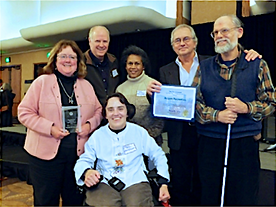
Georgena and her team accepting an award, 2012.
In 2017, Georgena, Sharon and Debbie stopped profiling trails and, instead, started training others how to do this themselves. Over the years that followed, I learned the ropes of trail description by taking that training and walking dozens of trails with Georgena and her team. I wanted to literally and figuratively walk in her footsteps. So, in 2024, I decided to start an AccessTrails project in my hometown of Tucson Arizona, calling it Tucson AccessTrails (TAT).
Building a rocket
When I got the idea to profile Tucson trails using the Guidelines, I asked my sisters to join me in what may have been a flight of fancy. Georgena and I are the youngest of five Moran sisters, making us #5 and #4 in birth order, respectively. I asked Jeanne (#2) to build a website, even though she had no experience in website development. I said, “No problem. I’ll give you a whole year to do it.” I asked Molly (#3) to make narrated videos – again with no experience – from photos and descriptions that I provided. Donna (#1) agreed to beta test the whole project and provide unbiased feedback. My four sisters joined me on an outdoor adventure of a very different kind.

Molly and Jeanne hiking Tanque Verde Rim Trail, 2025.
After one year, in 2025, we published the beautiful TAT website (thank you, Jeanne) with information and videos (thank you, Molly) for 17 Tucson trails. But we didn’t have a domain name, any search-engine presence nor even a license for our Wix web application. We were an all-amateur organization and it showed. Then, a miracle happened. We made an appointment with Dr. Bob Liu (User Experience Designer and Strategist, UX@UA) at the UA Library for advice on how to proceed. Bob asked, “Are you ready to do this?” Within an hour, we had a domain, a Wix premier license, and a UA graduate student, Linda Boroquez-Lopez, dedicated to our project. Our rocket was on the launchpad.
Launched and In Orbit
Soon thereafter, we held a meeting at the City of Tucson Parks and Recreation office for 10 city/county/state/national trail managers to officially launch Tucson AccessTrails. Two of our supporters – Tohono Chul Park and Santa Cruz Valley Heritage Alliance – encouraged us to incorporate as a non-profit organization. My husband David Shannon bought a book titled How to Form a Nonprofit Corporation and within weeks we were incorporated and applying for grants.
Now in our third year, 2026, we have a logo, bylaws and 3 generous grants in recognition of our quality product and value for the community of hikers with disabilities. We have profiled 31 trails in and around Tucson, from the peak of Mt. Lemmon to the rim of Tanque Verde Canyon. Our trails range from perfectly paved routes to rugged surfaces with roots, rocks and ruts. We are expanding from Tucson Metro Area to the entirety of Southern Arizona reaching Yuma in the west and Safford in the east. TAT interns, volunteers and my talented daughter Sarah help with data processing and website work. We have contracted hikers with blindness and cognitive disabilities to review and upgrade the accessibility of our original website. As a result, TAT trail descriptions have attracted 1000s of Arizona hikers using wheelchairs, walkers, canes, braces, and strollers. Our rocket is launched, in orbit and ready for attention.

Linda Rainville hiking Sweetwater Wetlands Park with a walker, 2025
Our Mission Going Forward
There is one thing we know for sure: Everyone should have the opportunity to enjoy the outdoors. TAT’s mission is to provide critical information about recreational trails in the Tucson region for people with physical and cognitive disabilities. But our dream is much bigger. In the near term, we plan to add trails across all of Arizona, starting with the network of Arizona State Parks and Trails. Beyond that, we plan to share our TAT website design with other cities and states so they can get a headstart on the next AccessTrails location. Our long-term goal is to promote Georgena’s dream to set a new standard that should be applied to all trail descriptions, everywhere.
TAT has been a labor of love, not only for the mission, but for our Moran sisterhood. Our parents passed away years ago, but we often wonder what they might think of us working together on one project conceived by their youngest daughter. They would have a good laugh.
We would love to hear from you through our Contact Us page.
And and please visit our Blog for the latest news.

Donna, Jeanne, Georgena, Mom and Molly hiking West Fork Trail in Sedona, 1996